Part 4: San Francisco, CA – Community Benefit Districts and the ‘Ambassador’ State
HOA Detective™ | Feb 20, 2026: Special Series Preamble: This article is Part 4 of a special series by the HOA Detective™ examining the rise of a “Private Metropolis” technostate ¹ – a creeping governance layer that is reengineering and steadily replacing traditional municipal models with privatized, assessment-funded systems of control, service delivery, and rules enforcement. Among the various entities that are utilized by the designers of the techno state are:
- Privatize Special Districts (PSDs);
- Business Improvement Districts (BIDs);
- Community Benefit Districts (CBDs);
- Enhanced Service Districts (ESDs);
- Special Service Areas (SSAs);
- and similar legal constructs that levy mandatory assessments to provide quasi-public services.
City Snapshot: San Francisco doesn’t call them Business Improvement Districts (BIDs) as often as other cities do. The preferred label in the legendary City by the Bay is Community Benefit District (CBD). The branding is softer, more “California,” but the mechanism is the same: draw a boundary, levy a mandatory assessment, and stand up a quasi‑public organization to deliver services the city can’t (or won’t) provide at scale.
Since the early 2000s, San Francisco has created CBDs in Union Square, the Tenderloin, SoMa, Fisherman’s Wharf, Japantown, Castro/Upper Market, and other high‑visibility zones – commercial corridors and tourist districts where “clean and safe” is treated less as a civic value than as a revenue imperative.
The organization San Francisco Planning states that the OEWD oversees 18 CBDs and lists them as Castro, Central Market, Civic Center, Discover Polk, Downtown, Fisherman’s Wharf, Greater Rincon Hill/East Cut, Japantown, Lower Polk, Moscone Expansion District, Noe Valley, Tenderloin, Ocean Avenue, SoMa West, Top of Broadway, Tourism Improvement District, Union Square, and Yerba Buena. ²
Purpose and Mission: In San Franciscothe usual “clean & safe” optics have been used to sell the idea of CBDs, while, like other cities in this series, the question of why city or county government can’t manage to deliver clean and safe streets is rarely, if ever, discussed.
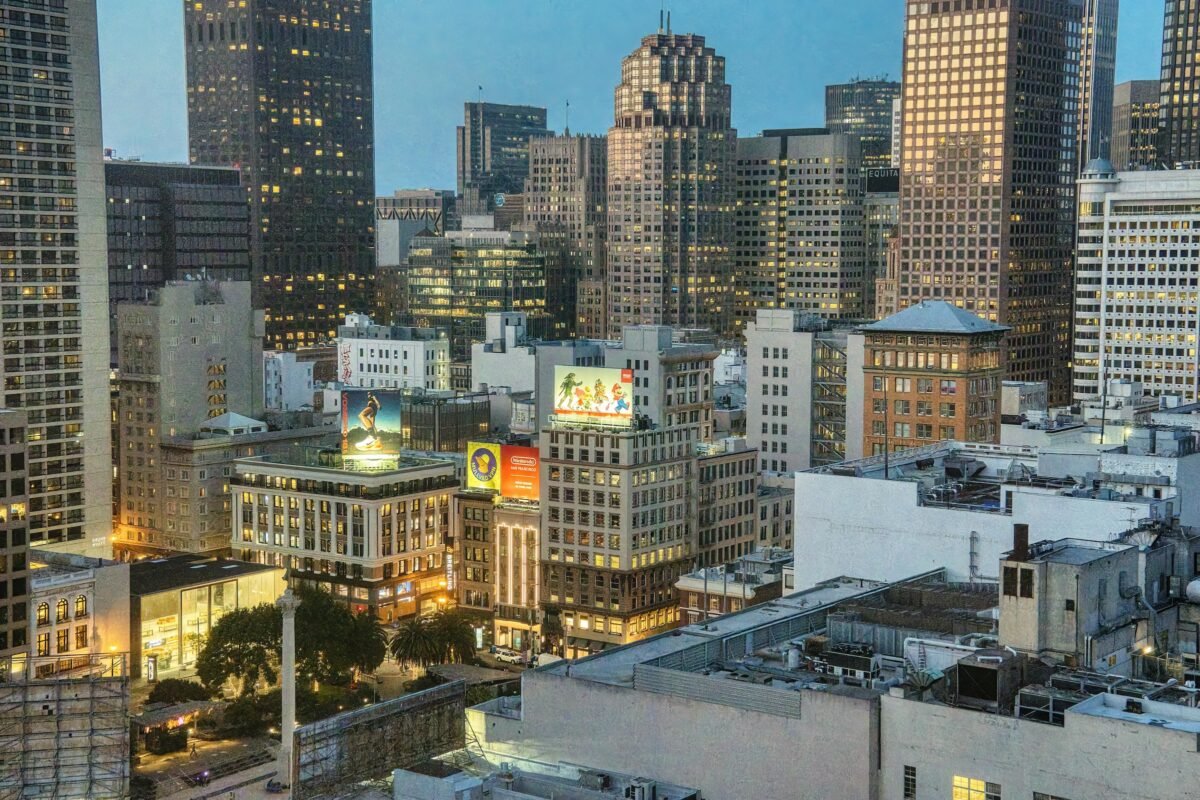
In CBD nomenclature, municipal functions are repackaged as “supplemental services.” San Francisco’s fabled Union Square CBD ³ is the archetype: uniformed “ambassadors” sweeping sidewalks, power‑washing grime, offering directions, and quietly acting as human perimeter fencing for retail and hotels. In the Tenderloin, crews pick up needles and trash and respond to street crises that the city’s fragmented systems struggle to contain. In Fisherman’s Wharf, the CBD bankrolls extra cleaning and visitor services to protect the postcard reputation of the area. These are not exotic services. They are the basic operating responsibilities of public works, public health, and public safety – re-routed through a private board and funded by a localized tax that most residents never voted on.
Most important to the Private Metropolis model is that the revenue stream needed to support such services is open to exploitation by for-profit, private-sector corporations. The stated argument in support of the PSDs is that their services are “supplemental.” The structural reality is that once a CBD exists, the political pressure to fully fund baseline city services weakens because the CBD is handling the “problem” of keeping the streets “clean & safe,” or whatever the stated objective may be.
Governance and Oversight: Better than some cities, but far from democratic,
San Francisco’s CBD program is often described as more ‘structured’ than the free‑range version seen elsewhere. Oversight and technical assistance run through the Mayor’s Office of Economic and Workforce Development (OEWD). CBDs file annual reports, and in theory are required to appear before supervisory committees for annual review. Renewal cycles for the CBD’s charter (often 10–15 years) force periodic reauthorization votes by assessed property owners. Those steps generate documents and hearings, which is more than many cities demand. ⁴
Don’t confuse paperwork with public control, however. Formation and renewal of CBD charters are built on weighted property-owner petitions and ballots. The one-dollar, one-vote practice means those who pay the most in assessments have more sway, even when the rhetoric says “community.” Boards are typically dominated by major property owners and merchant interests, because that’s who pays the assessment and that’s who has the bandwidth to govern. Day-to-day decisions – who gets contracted for security, how ambassadors are deployed, what behaviors are flagged, what street corners and sidewalks are “managed” – remain private operational choices. The public can technically attend meetings, but rarely does, because the system is designed to run below the civic radar.
Mandatory Assessments and a Two-Tier City: CBDs levy special assessments on properties within their boundaries using management-plan formulas (frontage, square footage, and other proxies for value and benefit). Large districts can generate multi‑million‑dollar budgets; across the city, CBDs collectively spend tens of millions annually on cleaning, security, and marketing. San Francisco has also supplemented some CBD budgets with grants or emergency support (notably during the COVID‑era downtown decline), reinforcing the central paradox: a district is sold as a self-funded solution, then becomes a convenient conduit for city dollars when optics demand rapid action.
The distributional effect is predictable. Areas with concentrated retail and hospitality wealth can purchase higher service levels – cleaner sidewalks, faster graffiti response, more uniformed security presence – while neighborhoods without that assessment base live with thinner baseline services. The result is not merely “local control.” It is a two‑tier city where civic normalcy becomes a subscription-based service delivery model.
‘Ambassadors’ as Quasi‑Policing: The sharpest fault line is enforcement. San Francisco’s CBDs do not just maintain sidewalks; they shape who is permitted to occupy them. “Ambassador” programs are deliberately ambiguous; part hospitality, part surveillance, part informal enforcement. When the district’s mission is to improve “quality of life,” the easiest variable to manipulate is visible poverty. Street disorder is not solved; it is simply relocated.
This power is rarely a formal arrest authority. It is the daily accumulation of low‑level coercion: telling people to move, calling in police, pressuring businesses to refuse service, and creating a district-wide norm that certain types of people are “out of place.”
This is where the CBD model becomes a moral hazard. A city is supposed to manage conflict through democratic accountability and due process – at least that’s what the Founding Fathers thought when they wrote the Constitution. A CBD, by contrast, is incentivized to protect commerce and public perception. In practice, that means the sidewalk becomes a managed asset. If you are a shopper, you are the customer – a source of revenue. If you are unhoused, mentally ill, or simply broke, and in the wrong place, you are treated like a human contamination risk.
Meanwhile, the CBD has no moral imperative to improve the lot in life of the people within its boundaries, with humanity as the ultimate guardrail – no social contract to fulfill. Rather, the bottom line of the assessment-paying stakeholders within the district dictates all aspects of the CBD operations.
Tangible Benefits? The short answer is, YES. CBDs do produce real, measurable benefits for those involved. They collect tons of trash, remove graffiti, and keep high‑traffic corridors looking ‘functional’ during periods when city systems buckle. They host events, fund public art, and provide a single point of contact for merchants who want an immediate response rather than municipal queueing. Some districts have partnered with nonprofits and transitional-employment programs to staff cleaning crews, offering legitimate work pathways that can help people stabilize. These are real benefits, and they are exactly why CBDs are hard to challenge politically.
The problem is that success on the surface can conceal the deeper trade-off: municipal functions are being privatized not only in delivery, but in priority-setting. The district decides what counts as a problem worth solving, and those priorities are weighted toward property-value protection, all without being subject to the ultimate democratic tool – the popular vote. The fact that a Wall Street hedge fund, or a sovereign wealth fund, may be the biggest monetary beneficiary of the CBD revenues stream never enters the conversation.
Democratic Deficit, Gentrification, and Privatization of Humanity: San Francisco’s CBDs face persistent criticism from homelessness advocates and civil liberties groups who argue that districts function as an extra policing layer without the accountability rules that govern the public police. This critique is blunt and vocal, as anyone who has spent time in San Francisco knows. CBDs operationalize a consumer-defined city where human suffering is treated as a threat to retail foot traffic.
Research on California improvement districts has also linked BID/CBD growth to the spread of ‘quality-of-life’ ordinances (sit/lie restrictions and similar measures), suggesting that districts don’t merely respond to the legal environment – they help create it. ⁵
Even when there is no scandal, the governance structure of CBDs creates an accountability deficit. If you are a low-income resident in the Tenderloin, a CBD can materially shape your daily environment – cleaning schedules, security presence, street interactions – without you having meaningful representation. That is the HOA logic exported into public space governance: decision-making by those who can afford to pay, and those who can afford to serve on a Board of Directors with no compensation – decisions that impact everyone else who lives in the district.
Bottom Line: San Francisco illustrates the PSD endgame in its most polished form. The city can point to oversight, annual reports, and renewal hearings. But the system still concentrates power with property interests, normalizes quasi‑policing through “ambassadors,” and converts basic municipal obligations into a pay-to-play service layer. The question is not whether CBDs can clean sidewalks. The question is what happens to democracy, human decency, and empathy when the city’s core functions are increasingly routed through private boards and for-profit corporations that treat public space as a managed product.
Notes | Sources
1. Technostate (techno-state – A governance regime where public functions are increasingly run through technocratic and technology-enabled systems (metrics, platforms, surveillance, compliance), shifting power from elected accountability toward managerial control by agencies and contractors, justified as “efficiency” and “risk management.”
2. https://projects.sfplanning.org/community-stabilization/commercial-district-planning.htm
3. San Francisco Business Times, Union Square – https://www.bizjournals.com/sanfrancisco/news/2024/10/25/tourism-safety-rebound-union-square.html
4. San Francisco Board of Supervisors Legistar – https://sfgov.legistar.com/MeetingDetail.aspx?GUID=4F7E4972-8957-4614-9683-27BB530ACCB0&ID=1166642
5. Martin Levine, “Who Is the ‘Neighborhood’ in Neighborhood Improvement Efforts?” –
Because You’re Buying More than a Home!