HOA Detective™ | March 6, 2026: Special Series Preamble: This article is Part 7 of a special series by the HOA Detective™ examining the rise of a “Private Metropolis” technostate ¹ – a creeping governance layer that is reengineering and steadily replacing traditional municipal models with privatized, assessment-funded systems of control, service delivery, and rules enforcement. Among the various entities that are utilized by the designers of the techno state are:
Privatize Special Districts (PSDs)
Business Improvement Districts (BIDs)
Community Benefit Districts (CBDs)
Enhanced Service Districts (ESDs)
Special Service Areas (SSAs)
Security Taxing Districts (STDs).
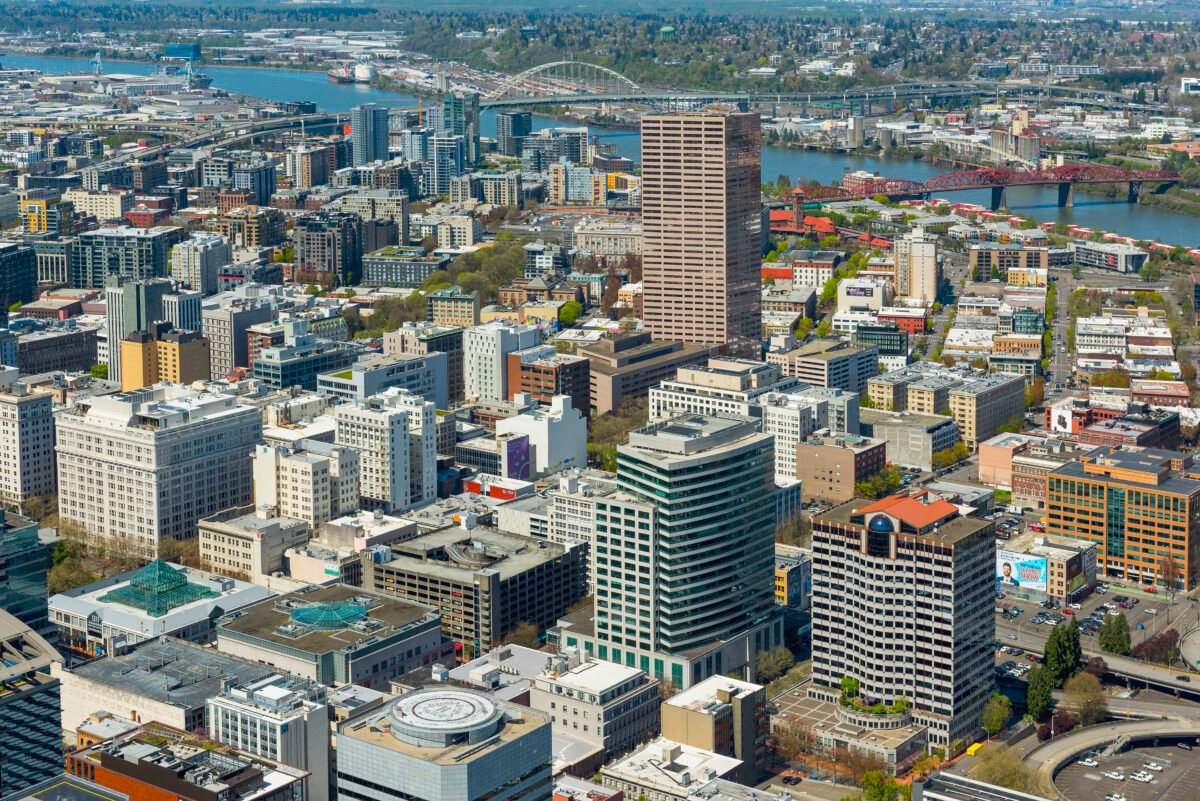
City Snapshot: Portland’s downtown Clean & Safe District is a revealing PSD/ESD case because it combines longevity, political visibility, and a documented oversight breakdown. It is a BID by another name – an Enhanced Service District (ESD) – funded by mandatory fees within the district boundary. What makes Portland worth a closer look is not simply that the model exists, but that the City Auditor has already documented a governance failure mode in a 2020 City Auditor’s Report on Portland’s inner-city ESDs, which make up the core of an expanding PSD/ESD network within the city.
Meanwhile, as residents and visitors can attest, the downtown core of the City of Roses is anything but Clean or Safe! Portland’s ESD ecosystem is also compact enough to study as a system rather than a sprawling Monsterplex. The city describes Clean & Safe as “one of three” ESDs in Portland, alongside the Central Eastside Industrial District and the Lloyd District.²
Portland isn’t dealing with dozens of overlapping districts, at least not yet. Compared to Chicago, LA, or NY, the taxpayers in Portland, Oregon must put up with a comparatively small number of PSDs that collectively function as a test ground for the Private Metropolis model – cleaning, safety presence, business development, and political messaging – delivered through quasi‑private entities authorized and administered by the city government. Portland is also home to a handful of covenant-controlled, developer-created “community associations”, but when compared to the largest cities we have examined, Portland’s PSD/ESD mélange is a drop in the proverbial bucket.
Service Claims vs. Service Reality: What the city is really “selling” according to
Portland’s official description is blunt; vested property and business owners fund extra services such as trash cleanup, graffiti removal, community safety, and business development through the City’s ESD program. ³
The Clean & Safe’s public sales pitch emphasizes sanitation, “ambassadors,” and a cleaner downtown – visible outputs that many stakeholders want and that municipal bureaus often struggle to deliver consistently at scale.
Comparing ESDs to HOAs: The results are only half the story – the governance question is the other half. How a quasi‑private organization sets enforcement priorities, how it interacts with vulnerable populations, and how the City supervises the entity once the arrangement becomes politically convenient has evolved into a major controversy.
The ESD to HOA comparison exposes one administrative reality: the moment you demand payment for an enforcement and maintenance layer, you also become a buyer, ultimately a provider of services. One that requires a decision-making body, i.e., Board of Directors (BOD). If it seems like you have heard this story before, you have.
The ESD decision-making engine increasingly defines “quality of life” issues for the residents and business owners through the procurement process. To achieve the best results, one must pay the most.
Portland’s ESD program is explicit in the foundational logic. ESDs exist to deliver “enhanced” services, which means a second layer of public‑realm operations funded by localized fees rather than general taxation.³ The City may consider the logic pragmatic, but it still begs the question:
‘What happened to the concept of a “Clean & Safe” commons for the benefit of ALL citizens, paid for, and governed by a democratically elected, local government council, who also benefit from the social contract?’
Breach of the Social Contract: Through the HOA Detective™ lens, it looks like a BREACH of the social contract that calls for a clean, safe living/work environment for all citizens, regardless of the individual’s ability to pay, much less the ability to own real property. Public services for profit, or only for those who can afford them, is the most fundamental breach of the Founding Fathers’ ideal of a civil society.
Public government functions migrating into semi‑private governance structures, where accountability is thinner, representation is narrower, and enforcement can be outsourced, is the very antithesis of what the American Revolution was about.
When the for-profit enterprise replaces the municipal service model, the public employee retirement model is replaced with the never-ending recurring revenue model that accrues mostly to a select group of well-connected businesses and individuals – all at the expense of under-represented public – “small d” democracy has been lost. Before you know it, a Wall Street budget committee is deciding how “clean & safe” your neighborhood will be, and at what cost to the taxpayers.
Governance and Oversight Stress Test: What the City Auditor found in
Portland, Oregon’s case is unusual because the Auditor’s office already put the core PSD problem in writing in a 2020 report, in which the Auditor acknowledged that the city “provides little oversight of privately funded public services,” even though the districts provide security and maintenance of public spaces. ⁴
The Auditor’s highlights sharpened the finding. Districts provide security and maintenance in public spaces “without the level of transparency and accountability required for similar services managed by the city.” ⁵
In a nutshell, the 2020 City Auditor’s Report is the thesis of the Detective’s entire series on PSDs – in audit form. What we are really asking is the rhetorical question:
‘How and WHY are privatized service districts allowed to operate in public spaces, delivering enforcement-adjacent functions and manage to escape the oversight and disciplinary rules that constrain public agencies?’
The Auditor’s Report also identified a structural gap in the bureaucracy. Turns out the city of Portland provides no formal guidance for how to form ESDs, no guidance regarding governance or allowable services, and “little oversight of public safety or other services provided in public spaces.” ⁵
If you want to understand the Private Metropolis menace, start here. The legitimacy problem is not whether a district picks up trash. The legitimacy problem is whether the city has built enforceable standards for what a privately managed, fee-funded public-space operator is allowed to do – and at what cost, especially when “public safety” is on the menu.
Funding and Duplication of Services: Portland’s ESD ecosystem is an uncomfortable backdrop that frames the PSD contradiction perfectly. If the City is already collecting taxes for downtown services, why must property owners (and ultimately tenants and residents through rent pass‑through) pay again for baseline cleanliness and safety? The rhetorical shield is “supplemental services.”
The operational reality is harder to verify because substitution happens quietly. Once a district exists, the political system can treat it as a relief valve for complaints and service deficits, while baseline performance can degrade without a visible line between who is and who is not responsible. “We cut downtown cleaning because Clean & Safe exists,” so the argument goes. The City’s own ESD pages describe the program as “enhanced services,” not emergency services.
Yet the Auditor forced the city to confront the obvious: once a multimillion‑dollar district becomes the de facto operating layer in public space, the city must either regulate it like a public service system or admit it has created a privatized carve‑out for public‑realm governance. The audit’s recommendations included revisiting the districts’ purpose and the City’s responsibility, and developing guidelines if districts continue operating in public space. ⁵
Expansion Politics – When the District Metastasizes: A key element of Portland’s PSD/ESD dynamics is expansion. Once a fee-funded service layer is normalized, the next move is to extend the boundary and recruit new payers. In 2024, Downtown Portland Clean & Safe petitioned the city for revised boundaries, a rate structure overhaul (including residential rate caps), and a new ten‑year reauthorization. ⁶
By November 2024, the City Council approved expansion from 213 blocks to 273 blocks, and renewal for another decade, with new rates taking effect October 1, 2025. Do the math, and you find this represents an increase of the Clean & Safe footprint of 28%.
Portland’s ordinance language is unambiguous: the Clean & Safe property management license fee is renewed for ten years “with the expanded district boundary and new license fee rates beginning on October 1, 2025.” ⁷
PSD Creep in Plain English: The district becomes politically normalized, then boundaries and fees are revised to bring more properties into the assessment regime. Considering the poor job the district has done keep its sidewalks “Clean and Safe,” one must wonder if things are going to improve now that the district is even larger
Expansion matters because it changes who pays and who is governed. A boundary change is not a map edit; it is a governance extension. It extends the district’s service priorities, contracts, and public-space norms into new blocks – often with ratepayer outreach that is legally adequate but civically anemic. Portland’s ESD program framed the petition as a “ratepayer-notification” communication event. If you got the mailer, it meant you were in the right place. ⁸ That is governance by notice, not democratic participation.
Portland ESDs – Systematic Metastasis: Clean & Safe is most alarming when viewed as part of a three‑district system. The city identifies three ESDs: Clean & Safe, Central Eastside Industrial District, and the Lloyd District ESD.
The Central Eastside Industrial District is described as “one of three” ESDs where property owners fund enhanced services such as trash cleanup, graffiti removal, and business development. ⁹ Central Eastside Together’s own communications describe “safety, cleaning and district enhancement … beyond the City of Portland’s basic services,” funded through a city-administered property management license fee distributed to the district entity. ¹⁰
That “beyond basic services” phrase is the signature of the Private Metropolis: a second layer becomes normal because the baseline is implicitly treated as insufficient.
The Lloyd District ESD is also framed as “one of three” districts funded by property owners for trash cleanup, graffiti removal, and business development. ¹¹ Lloyd’s materials describe the ESD as established in 2001 with core programs supported by a property management license fee and a public-safety focus among other priorities. ¹²
Portland Metro ‘Near‑ESD’ Ecosystem: In Portland, the ESD model has sprung a leak, with City-authorized ESD programs as the only channel for privatization drift. The metro region also contains “near‑ESD” governance wrappers – district-scale entities created by master-planned redevelopment, covenants, or developer-era agreements. These structures can replicate the Private Metropolis outcomes (cost + control + service substitution pressure) without the same audit visibility that attaches to formal City ESDs.
South Waterfront Community Association (SWCA) and the Zidell Yards ESD Proposal: Portland’s South Waterfront is a master-planned redevelopment zone with multiple governance layers. Most importantly, there is a documented effort to create a new South Waterfront ENHANCED Service District tied to Zidell Yards (described as the future MLB ballpark site).
A Portland Metro Chamber letter dated May 15, 2025, explicitly requests the formation of a South Waterfront ESD and frames it as “common practice nationally” for ballparks to have their own ESD to ensure supplementary cleaning and services, while positioning the Chamber as the nonprofit vehicle for the district. ¹⁴
That letter is the clearest evidence that Portland’s ESD model is not limited to the three existing districts. It shows the predictable catalytic-development pattern: large project + service expectations + proposal for an assessment-funded operating wrapper to carry the ‘supplemental’ burden.
John’s Landing – a Blast from the Past: The 1970s era covenant‑based Johns Landing Commercial Areas Association (JLCAA) is an early relic of the privatization movement in Portland. The JLCAA illustrates how the privatization channel can work over time and in smaller steps. The JLCAA documents describe an association created by the developer in 1974 “to control the improvement, maintenance, occupancy and use” of certain commercial areas within the Johns Landing neighborhood south of Downtown. The JLCAA is supported by governing instruments such as CC&Rs and bylaws in a manner that seems almost archaic in the 21st century. ¹⁵
The JLCAA is not a City ESD. It is not a noble gesture by a well-meaning developer. It is the HOA template applied at the commercial-district scale. The covenant-driven governance wrapper can impose standards and costs within a defined redevelopment area without any government oversight at all. The JLCAA functions are parallel to a service district in terms of outcomes, but are created through a private contract rather than a public ordinance.
Cascade Station / Airport Retail District: Cascade Station is a different kind of districtization: land-use governance by code rather than service governance by assessment. Portland’s zoning code establishes the Cascade Station/Portland International Center Plan District (33.508), describing a formal plan district framework to guide development near Portland International Airport. ¹⁶
A plan district is not an ESD, but it is still a district governance stack mechanism: the City creates a specialized rule regime for a defined area to accelerate and shape redevelopment outcomes. If any ESD-like service layer emerges around Cascade Station (cleaning, security, marketing), it would likely appear as an additional wrapper on top of the plan district. For now, the plan district itself is the verifiable governance layer.
Hoyt Street Yards Community Association (HSYCA): The HSYCA is another master-planned redevelopment sub-area where governance can drift into privatized layers. Once the shining gem of Portland’s Pearl District, the HSYCA is registered as an Oregon nonprofit corporation, functioning as a “community-association.” ¹⁷
The Pearl District already has a recognized neighborhood association (PDNA), and the city notes that The Fields Park is situated within the Hoyt Street Yards portion of the PDNA. HSYCA is therefore best understood as an additional, parallel layer that can shape standards, costs, and district coherence inside a master-planned zone –
without being a city-created ESD.
Portland’s ESD Failure is Institutional: When a city treats ESDs as convenient service patches while failing to build enforceable oversight – complaint intake mechanism, use-of-force reporting standards, vendor accountability, and clear boundaries on enforcement – it effectively licenses privatized public-space control.
Portland, Oregon, demonstrates the failure mode of PSDs with unusual clarity. When a private-service district becomes the de facto downtown governance layer precisely when the city most needs political cover for hard problems (poverty, addiction, street disorder, and lack of affordable housing) it is a capitulation of representative governance, and a rejection of self-governing democracy.
Portland’s ESDs exist for the same reason they do in other cities: to solve visible PR problems and commerce concerns. The public pays by giving up government legitimacy, population displacement pressure, and diminished voter control – especially when expansion and renewal are treated as administrative events rather than civic decisions.
Because You’re Buying More than a Home!
Notes | Sources
1. Technostate (techno-state – A governance regime where public functions are increasingly run through technocratic and technology-enabled systems (metrics, platforms, surveillance, compliance), shifting power from elected accountability toward managerial control by agencies and contractors, justified as “efficiency” and “risk management.”
2. City of Portland, “Downtown Portland Clean & Safe District” (Enhanced Services District program overview). https://www.portland.gov/esd/enhanced-services-districts-overview/downtown-portland-clean-safe
3. City of Portland, “Enhanced Services Districts Overview” (program description). https://www.portland.gov/esd/enhanced-services-districts-overview
4. City of Portland Auditor, Audit Services, “Enhanced Services Districts: City provides little oversight of privately funded public services” (Aug. 13, 2020). https://www.portland.gov/auditor/audit-services/news/2020/8/13/enhanced-services-districts-city-provides-little-oversight
5. City of Portland Auditor, “Enhanced Services Districts” – report highlights (download). https://www.portland.gov/auditor/audit-services/documents/enhanced-services-districts-report-highlights/download
6. City of Portland, ESD Program News, “Downtown Portland Clean & Safe petitions the City of Portland for expansion & rate structure” (Aug. 15, 2024). https://www.portland.gov/esd/news/2024/8/15/downtown-portland-clean-safe-petitions-city-portland-expansion-rate-structure
7. City of Portland Council, Ordinance 191960 (Clean & Safe renewal with expanded boundary and new rates beginning Oct. 1, 2025). https://www.portland.gov/council/documents/ordinance/passed/191960
8. Downtown Portland Clean & Safe, “Clean & Safe District expansion approved by Portland City Council” (Nov. 14, 2024). https://downtownportland.org/clean-safe-district-expansion-approved-by-portland-city-council/
9. City of Portland, “Central Eastside Together” (Central Eastside Industrial District ESD overview). https://www.portland.gov/esd/enhanced-services-districts-overview/central-eastside-together
10. Central Eastside Together, “Central Eastside Together hires Securitas…” (safety/cleaning beyond City basic services). https://centraleastside.biz/news/central-eastside-together-hires-securitas-as-districts-new-safety-provider
11. City of Portland, “Lloyd Enhanced Services District” (overview). https://www.portland.gov/esd/enhanced-services-districts-overview/lloyd-esd
12. Lloyd District, “About Us” (property management license fee; public safety focus). https://www.lloydpdx.org/
13. Portland Mercury, “Audit Finds City-Approved Business Districts Rely on Unregulated Policing” (Aug. 13, 2020). https://www.portlandmercury.com/news/2020/08/13/28731801/audit-finds-city-approved-business-districts-rely-on-unregulated-policing
14. Portland Metro Chamber, letter requesting formation of a South Waterfront Enhanced Service District at Zidell Yards (May 15, 2025). https://portlandmetrochamber.com/wp-content/uploads/2025/05/20250516-SWaterfront-ESD-letter.pdf
15. JLCAA Documents page (Johns Landing Commercial Areas Association –developer-origin governance wrapper; CC&Rs/bylaws/articles links). https://jlcaa.wordpress.com/about/
16. City of Portland zoning code, “Cascade Station/Portland International Center Plan District” (33.508) PDF. https://www.portland.gov/sites/default/files/code/33.508-cascade-station-portland-international-center-cs-pic-plan-district.pdf
17. OpenCorporates, “HOYT STREET YARDS COMMUNITY ASSOCIATION, INC.” entity record. https://opencorporates.com/companies/us_or/64337588