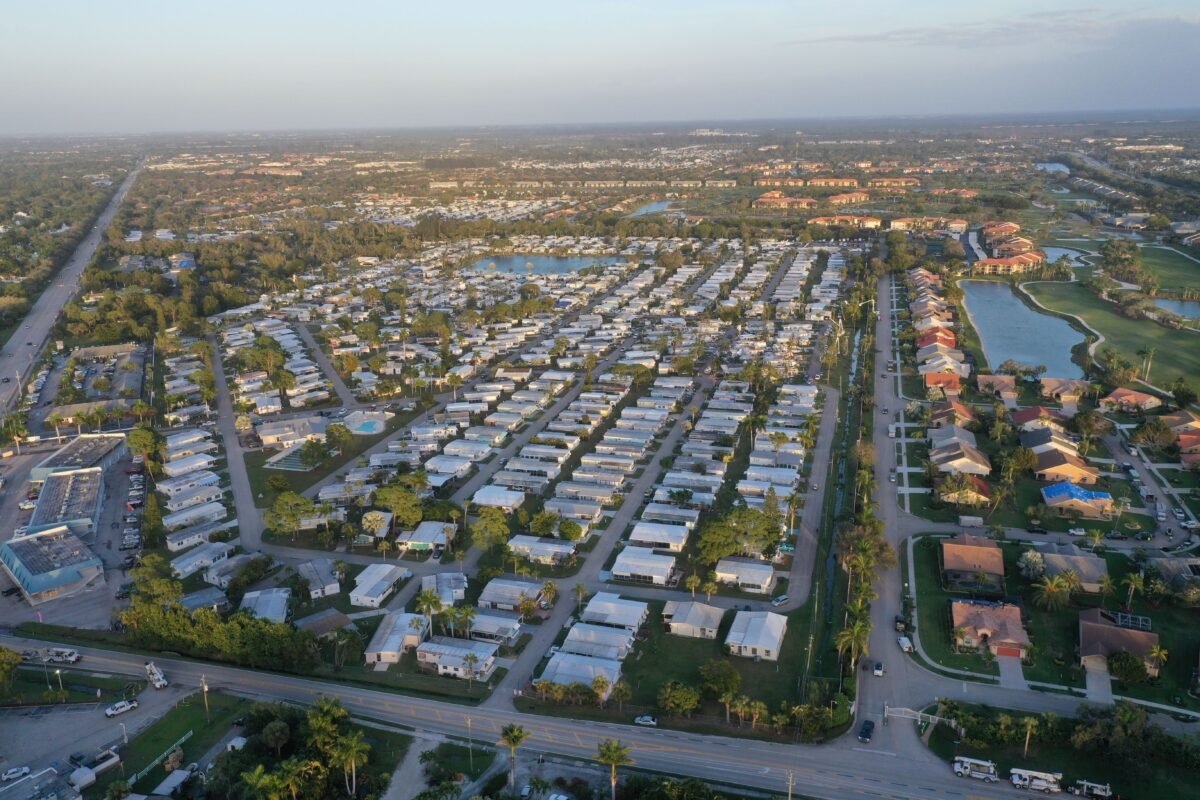
“We aren’t in Florida, Toto.”
HOA Detective™ | June 19, 2026: If a time traveler from 1975 arrived in a typical American housing development today, they might conclude that something had gone terribly wrong.
In 1975, the typical American family expected that homeownership meant a detached house on its own lot. The home likely had a front yard and a backyard. It probably included off-street parking and often a garage. Living space within a typical 70s-era home would have been 1200-2,000 square feet.
Most importantly, the owner controlled the property with minimal interference from private governing bodies. Homeowner Associations (HOAs) existed, but they were far from the dominant force they would become if our time traveler had stuck around for half a century.
Fast Forward Fifty Years: Today, the national median existing-home price hovers around $420,000. In many metropolitan areas, the figure is dramatically higher. Yet the housing available at or near that price point often consists of attached townhomes, condominiums, stacked flats, or small-lot developments governed by HOAs.
- Private yards are smaller or nonexistent.
- Private parking is rare; new homes have NO PARKING at all.
- Shared parking is constrained when it does exist.
- Single-owner garages are rare.
- The shared garage space in your condo building is regulated like a schoolyard.
- Common walls are normal.
- Highly regulated, shared amenities have taken all of the fun out of a pool.
- The ceiling of your new home is the FLOOR of your neighbor’s house above.
- HOA assessments are virtually guaranteed.
Americans are paying more money for housing than at any time in the history of the country if we use the long-standing economic metric, Median household income vs. Median Home price.
To put it bluntly, MORE money for a LOT LESS house.
Inquiring Minds Want to Know: How did we get from the1975 housing model to this disastrous state of affairs? The answer requires examining several overlapping forces that transformed American housing over the past half-century.
The first factor is simple price escalation. According to U.S. Census Bureau data, the median price of a new home sold in the mid-1970s was approximately $39,000. Median household income was roughly $13,700. In other words, the median home cost less than three times median household income.
It is worth noting that only five years earlier (circa 1970), the median home price had been pegged at ~$24,000 while median household income was hovering around $10,000/yr.
Today, median household income is approximately $80,000 while median home prices are near or above $420,000. The ratio has expanded dramatically. In many markets, housing costs now exceed five to six times annual household income. In certain coastal metropolitan areas, the ratio is substantially higher.
That single statistic may explain more about modern housing stress than any political slogan ever could.
The second factor is land. In 1975, large amounts of developable land remained available near many urban centers. As metropolitan areas expanded, local governments increasingly confronted infrastructure costs associated with growth. Roads, drainage systems, parks, utility systems, and public facilities all required funding.
Politicians, aided and abetted by the evolving field of urban planning, discovered an elegant two-part solution:
- Rather than expanding municipal obligations, governments increasingly encouraged private developments that would maintain portions of their own infrastructure. Homeowner Associations became the mechanism that made this possible.
- To stifle the growth of suburban development, the same municipal governments were morphed into a planning/permitting industrial complex that now controls the development process far more than at any time before 1975.
From Property Tax to Privatopia: Instead of taxpayers maintaining streets, stormwater facilities, parks, clubhouses, pools, and common landscaping, those responsibilities have shifted directly to the homeowners in the form of HOA assessments.
- Municipal budgets benefited.
- Creating HOAs was the path of least resistance for developers.
- The long-term infrastructure liabilities were shifted from the public sector to the HOA.
- The infrastructure costs may have been removed from the public ledger, but they did not disappear.
- Nor did taxes disappear – HOA members still pay property taxes; in most jurisdictions, the bill is FAR more.
- And now, 50 years later, HOA assessments are almost as certain as death and taxes, as the old saying goes.
This shift represents one of the least discussed, but most important changes in modern housing policy – Welcome to Privatopia!
Third Prong on the Cattle Prod: Yet another factor involves density. As land became more expensive and regulatory approval became more difficult, developers needed to generate more revenue from every acre they controlled. Detached homes consume more land. Townhomes and condominiums consume far less.
If a developer can place forty units on land that previously supported ten detached homes, the economics become obvious.
The result is higher density, smaller lots, shared amenities, and common interest ownership entities.
Taking this planning principle to the extreme is the high-rise condominium tower of 200-500 housing units all stacked up on top of each other, occupying a parcel of land no larger than a city block. Whereas a 1975-era housing development containing 200-500 homes could have easily required 50 to 200 acres of land, a 25-50 story high-rise condominium can be built on a single 200’x200′ city block, the equivalent of LESS than one acre of land.
Let that soak in: The equivalent of a 1975 residential subdivision containing 200-500 homes squeezed into the land mass equal to roughly ONE city block. All it takes is ONE high-rise building of 30 to 50 stories.
For the planner’s perspective, this appears rational. For developers, it frequently improves profitability. For local governments, it reduces infrastructure burdens DRAMATICALLY.
Property Tax Juggernaut: From the tax assessor’s perspective, it is the equivalent of a money-printing machine: 200-500 homes generating the same or more per-house property tax revenue, all squeezed on ONE acre of land!
For buyers, of course, it means no private space or outdoor space. Little to no parking, few private amenities, and a looming long-term capital renewal and replacement obligation that will stifle the best-laid retirement plans in a nano-second.
Regulatory complexity has increased: Modern development and construction operate within a vastly different regulatory environment than it did in 1975. Environmental regulations, stormwater requirements, accessibility standards, energy-efficiency mandates, permitting processes, impact fees, transportation requirements, and legal compliance obligations all increase development costs.
Many of these regulations address legitimate concerns. Few people want polluted waterways or unsafe buildings. However, regulations rarely come without cost. Each additional regulatory requirement increases housing prices. When combined over decades, the cumulative effect becomes significant.
The Commoditization of Housing: U.S. housing has gradually evolved from shelter into an investment vehicle. Not only for the owner/occupant who is seeking shelter, but increasingly for Wall Street hedge funds, sovereign wealth funds, and for-profit corporations whose sole purpose is to build, own, and rent housing.
The “5 over 1” (5 levels of residential units over 1 level of commercial space) in an urban location now litters the landscape of almost every major metro area of the county. These buildings now serve as a form of “surrogate housing” for a population who cannot afford to own any house.
When the 5 over 1 model is developed as a condominium, the result is small, cheap “apartment-sized” living space parked on top of a leased commercial space that may be a hair salon one day and a Sushi bar the next. All with no parking, no yard, and the noise of a trash truck making the weekly pickup at 4 am, as your “unhoused” neighbor sleeps in a cardboard box in the alley.
This commoditization/financialization trend has led to an acceleration of housing appreciation. Historically, homes appreciated slowly. The HOA Detective’s childhood home was bought by my parents for $9,500 in 1962 using VA financing, which meant no down payment – a “thank you” from the USGOV to my father who served his country not once but twice, as a Merchant Marine and the U.S. Army. Twenty-three years later, the home was sold in 1985 for $30,000.
Beginning in the late twentieth century, however, many Americans increasingly viewed housing as a primary wealth-building strategy. Tax advantages, favorable mortgage financing, institutional investment, and expectations of perpetual appreciation transformed market behavior.
The Two Crises: Investors entered the market. Speculation increased. Unmitigated greed led to Crisis #1: the collapse of the S&Ls in the 1980s.
Again in the 2000s, Crisis #2 was triggered by the collapse of an investment vehicle known as the subprime mortgage bond; a form of junk bond financing that should NEVER have been allowed to exist. The calamity that followed almost toppled the economy of the mightiest country in the free world. The fallout of these back-to-back crises includes:
- The U.S. home building industry has never recovered.
- U.S. new home production has never returned to pre-2008 levels.
- U.S. housing inventory is the lowest in the last four decades.
Two Groups of Wanna Be Owners: As a result, the U.S. is now confronted with not one housing shortage, but two overlapping shortages. Many entry-level homebuyers in 2026 can be classified as:
- Would buy, but cannot find suitable housing.
- Would like to buy, but cannot afford available housing.
Group 1 includes buyers that may have income, credit, and down-payment capacity, but the available inventory is wrong: too few detached homes, too few starter homes, wrong location, too much HOA/condo exposure, insufficient parking, poor condition, or unsuitable size.
Group 2 includes those households that would like to own rather than rent, but cannot qualify at current prices, mortgage rates, insurance costs, HOA dues, property taxes, and down-payment requirements.
The Rise and Arrival of Privatopia: Over the last six months or so, we have examined the origins of Community Associations Institute (CAI) and the individuals who helped shape modern HOA governance. Their work emerged during a period when policymakers, developers, planners, and industry professionals were searching for mechanisms to accommodate growth while limiting public obligations.
The common interest development/homeowner association model has been proven to be remarkably useful in this regard. What began as a relatively specialized development model evolved into a dominant framework for residential housing development.
According to CAI’s estimates, well over 70 million Americans now live within HOA-governed communities. In many metropolitan regions, finding new housing outside an HOA has become increasingly difficult. This reality would have seemed extraordinary to many Americans in 1975. The irony is impossible to ignore.
Housing advocates often describe higher-density housing as a solution to affordability challenges. In theory, density should reduce costs by spreading land expenses across more units. Yet many buyers discover that the savings are modest while the tradeoffs are substantial:
- The detached home becomes a townhouse.
- The private backyard becomes a common area.
- The garage becomes a shared parking arrangement.
- The most immediate “government” becomes an HOA board.
- The property tax bill remains.
- The HOA fee is added to the house budget and continues to increase.
- The purchase price of the homes in Privatopia continues to climb.
Some will argue that modern housing offers benefits unavailable in 1975. This argument would be correct. Today’s homes generally feature superior energy efficiency, improved building systems, better insulation, modern communications infrastructure, and higher construction standards in many respects.
The question is who gets to enjoy these benefits?
That question becomes especially relevant when examining condominium ownership. Condominiums represent perhaps the purest expression of modern housing economics. They maximize density. They minimize land consumption. They transfer significant maintenance obligations into collective governance systems.
In theory, they provide affordable ownership opportunities.
In practice, they frequently expose owners to reserve funding challenges, deferred maintenance risks, special assessments, insurance volatility, and governance failures. The 2021 Champlain Towers collapse demonstrated the extreme consequences of long-term infrastructure neglect. While that tragedy occurred in Florida, the underlying issues are hardly unique to Florida.
Condominiums throughout North America face aging infrastructure, rising maintenance costs, and reserve funding pressures.
This ain’t Florida, Toto: The reality is that building failure such as the Champlain Tower could happen almost anywhere in the country where similar buildings are used to house people, especially when the building is under the control of a condominium regime. The underlying mathematics travel remarkably well. What happened in Florida will not stay in Florida.
The broader lesson is that America’s housing transformation did not occur by accident. It emerged from thousands of individual decisions made by planners, policymakers, developers, lenders, investors, and industry organizations over many decades. Together they produced a housing landscape that would be nearly unrecognizable to many middle-class families of the 1970s.
- The detached home with a yard did not disappear. – it simply became increasingly expensive.
- The HOA did not emerge because consumers demanded private government.
- It emerged because private governance solved multiple problems for institutions responsible for managing growth.
- The condominium did not become common because buyers universally preferred shared walls.
- It became common because density solved economic and regulatory constraints.
Conclusion: Understanding these realities matters because housing affordability is not merely a question of supply. It is also a question of development structure. The onion still has many layers left to peel. But one conclusion grows harder to avoid with every passing year:
Americans are spending more than ever to purchase housing that often delivers less land, less privacy, less autonomy, and more collective obligations than previous generations considered normal. Whether that represents progress or merely adaptation remains an open question.
Because You’re Buying More than a Home!
Sources
1. Evan McKenzie, Privatopia: Homeowner Associations and the Rise of Residential Private Government (New Haven: Yale University Press, 1994).
2. U.S. Census Bureau, Historical Census of Housing Tables and Median Sales Price of New Houses Sold in the United States.
3. U.S. Census Bureau, Historical Income Tables: Households.
4. Joint Center for Housing Studies of Harvard University, The State of the Nation’s Housing, various editions.
5. Federal Reserve Economic Data (FRED), housing affordability and mortgage market datasets.
6. Community Associations Institute (CAI), National Community Association Statistics.
7. National Association of Realtors, Existing Home Sales and Median Price Data.