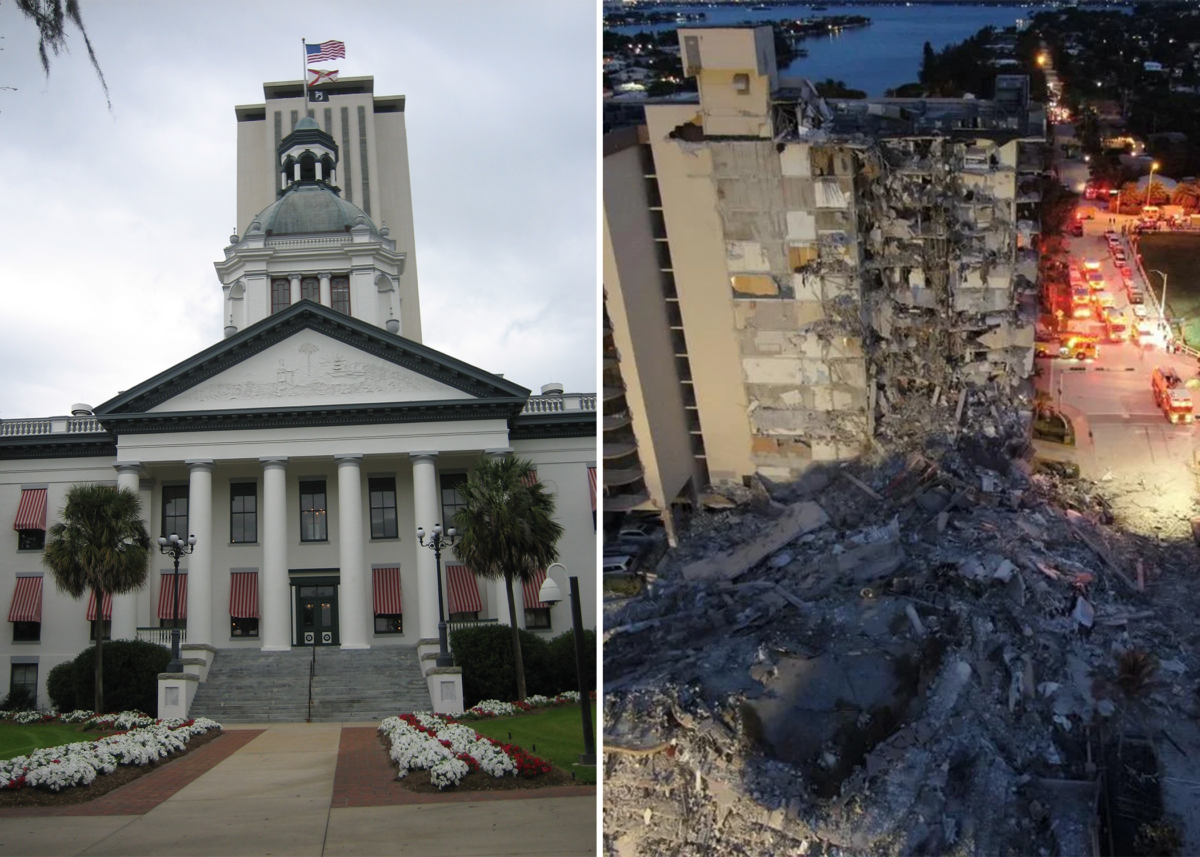
Editorial Note: June 24, 2026, marks the 5th anniversary of the Champlain Tower South Condominium collapse. The lesson was brutal: 98 dead (RIP). An estimated $200 million in property value is gone. Billions in liability claims. Five years later, the underlying causes still exist, despite the industry’s lip service and ongoing damage-control.
HOA Detective™ | June 23, 2026: Five years ago, in the early hours of June 24, 2021, a portion of Champlain Towers South Condominium (CTSC) in Surfside, Florida, collapsed under its own weight. Ninety-eight people died. The images were immediate and unforgettable: pancaked concrete, exposed rebar, bedrooms opened to the sky, families waiting for news that would not come.
Frankly, it was nothing less than horrifying!
Five years later, the technical investigation is still ongoing, and the cause is more complicated than originally thought. Meanwhile, the public memory is fading. The broader lesson was visible almost immediately. Let’s cut to the chase and call it like it is:
The Champlain Towers South tragedy was not merely a building failure. It was a governance failure, a funding failure, a maintenance failure, and a regulatory failure.
Most importantly, it was a major failure of the common interest property ownership model that has been force-fed to the American homebuyer. What we now know about the underlying causes can be summed up in four succinct statements:
- DEFERRED maintenance played a major role.
- UNDERFUNDED reserves played a major role.
- Lack of expertise at the board level played a major role.
- Local and state regulatory failures played a major role.
NOTE: The Defective is stopping short of pointing a finger at the CTSC manager, Scott Stewart. Thanks to the efforts of Dave Rauch, Stewart was given a chance to set the record straight regarding his role as the manager in the years leading up to the collapse. Links to Rauch’s two-part interview of Stewart can be found in the Sources. ¹
By his own account, Stewart’s hands were tied when faced with an uncooperative Client who did not understand the complexity of the maintenance issues involved, and a woefully underfunded reserve account.
The Same Cannot be Said About the Florida Legislature: Almost fifteen years before the collapse, Florida had adopted inspection requirements that might have applied to buildings like Champlain Towers South, but those requirements were repealed after political pressure when the “condo lobby” objected to the cost of implementation.
The result was predictable: fewer inspections, less planning, less financial discipline, and more room for associations to confuse affordability with safety.
A Day Late and 98 Lives Later: After the collapse, and with blood on its hands, the Florida Legislature had no choice but to legislate – 98 lives was the price paid by the doomed condominium community.
Senate Bill 4-D created a new framework for milestone inspections and Structural Integrity Reserve Studies (SIRS). For qualifying condominium and cooperative buildings, the law tied structural safety directly to long-term funding.
Before Surfside, reserve studies were too often treated as optional planning documents. After Surfside, Florida lawmakers made clear that reserve planning for critical building systems is fundamentally a life-safety function.
Post-Collapse Action: A handful of states followed with reforms. Maryland enacted statewide reserve-study requirements. Virginia strengthened reserve-study and disclosure obligations. Tennessee adopted reserve-study requirements for certain condominium associations. New Jersey enacted structural-integrity inspection and reserve-related legislation.
These are meaningful developments, but they do not constitute the sweeping national reform movement some critics had hoped for.
The Community Associations Institute (CAI) moved quickly after the collapse. Working groups were convened, policy materials were issued, and in 2023, CAI published revised Reserve Study Standards® (RSS®).
The long-overdue revised standards incorporated concepts such as preventive maintenance, deferred maintenance, periodic structural inspections, corrective maintenance, and structural-integrity considerations.
The Irony is Difficult to Ignore: The CTSC catastrophe exposed weaknesses in the reserve-study industry’s voluntary framework. The industry’s leading trade organization responded by revising those standards and copyrighting both the term Reserve Study Standards® and the RSS® acronym, as CAI continues its efforts to position the organization as the “international authority” on all things associated with the common interest development/HOA/condominium industrial complex.
The requirement for Structural Integrity Reserve Studies has nevertheless established a new benchmark. Ignoring the fact that there aren’t enough qualified engineers in the country to perform such inspections at the scale needed to achieve full compliance, the SIRS framework is no longer merely a “Florida concept.” It has become a reference point in national discussions regarding reserve planning, building safety, and long-term asset stewardship.
The Lesson is Unchanged: A condominium’s true cost is not the monthly assessment with a pittance for reserve funding. The true cost is the full life-cycle cost of the asset. Including inspections, robust maintenance, and even more robust reserve funding, sufficient to renew and replace expensive building components that have a finite service life. Not when the BOD feels like it, every year, beginning with the first year in the lifecycle of the building.
Postponing the maintenance of a building leads to deferred maintenance. Each year, the legacy systems in a building depreciate. The economic value that is lost to depreciation must be offset with replacement reserves if the market value of the units in an older building is going to remain stable
Deferred maintenance and underfunded reserves must be disclosed, not concealed.
Surfside was the most catastrophic example of what happens when deterioration, underfunding, governance limitations, and regulatory weakness converge. Five years later, the industry should be asking harder questions.
- Do we allow the BOD to defer major repairs because owners object to increased assessments?
- Do we allow the Association to hire the cheapest reserve-study provider simply because they don’t want to spend the money on a report nobody really understands?
- Do we continue to allow the Reserve Specialists® to use optimistic assumptions that understate the future reserve spending obligations simply because the client doesn’t want to raise the dues?
- Do legislatures still permit reserve waivers or include optional compliance language in the reserve study statutes?
- Will any state EVER mandate that the HOA provide a complete, accurate, and timely financial disclosure package to buyers?
- Will any mortgage underwriter EVER require current reserve studies and near-full funding of reserves if a condominium unit is going to become collateral for a 30-year mortgage?
These are the type of questions the industry critics like the HOA Detective™ have been asking for years. The response has been less than deafening.
The Proper Response is Discipline, not Panic: Mandatory reserve studies, meaningful reserve funding, recurring structural inspections, independent, validated expertise, transparent disclosures, and board education that treats infrastructure stewardship as a fiduciary obligation. This is the proper response.
2026 Sidebar: Adding to the intrigue five years later is professional engineer (P.E.) Josh Porter’s video, in which he discusses another uncomfortable layer to the Surfside story. In his video, “Crime, Corruption, and Incompetence – The History of Champlain Towers South,” ² Porter argues that the collapse cannot be understood solely through the final years of deferred maintenance. His thesis pushes the inquiry backward, into the original development, design, construction, permitting, inspection, and approval environment that produced Champlain Towers South in the first place.
Porter’s discussion does not prove that corruption at the local building department caused the collapse. But it does raise the question that should have been asked more forcefully from the beginning: how many institutional checkpoints failed before the building ever reached its 40-year recertification cycle?
If the final chapter of Champlain Towers South was written in reserve shortfalls, delayed repairs, board exhaustion, and owner resistance, the first chapter may have been written in South Florida’s development culture itself – a culture where speed, political access, construction economics, permissive approvals, and weak enforcement could combine to normalize risk long before residents understood what they had purchased.
Josh Porter’s Insight: Josh Porter’s framing is important because it resists the convenient post-collapse narrative that blames only the Association and inadequate reserves. The Association’s failures were real.
A condominium board inherits a building; it does not approve the original drawings, inspect the original work, certify the original construction, or run a background check on the original developer to determine if the operation is one step ahead of Johnny Law or embroiled in criminal activity. That responsibility lies with the local authorities, perhaps the state.
Five years later, the harder question is not simply whether the Champlain Towers South board should have acted faster. It is whether the public and private systems responsible for creating, approving, inspecting, funding, and regulating the building ever functioned as a true safety net at all. If they did not, then Surfside was not merely a reserve-funding tragedy. It was a full-stack failure of development, oversight, governance, finance, and enforcement.
Conclusion: Five years after the Champlain Towers South collapse, the tragedy remains a test. The test is whether legislatures, industry policy-makers, and HOA stakeholders have learned that near-term affordability without maintenance, adequate reserve funding, and competent stewardship is an illusion.
Have we learned that low assessments are a form of hidden debt?
Have we learned that building safety cannot depend on the owner’s willingness to pay for needed maintenance?
Have we learned that industry branding is little more than lip service to the failed 20th-century policies of an organization now half a century old that was only spurred into action after 98 people lay dead?
Sources
1. Dave Rauch, Pro Tech Building Services – interview of CTSC manager Scott Stewart:
Part 1: https://www.youtube.com/watch?v=5KZw3ToBd98
Part 2: https://www.youtube.com/watch?v=Xio3wHbeDyQ
2. Josh Porter – Crime, Corruption, and Incompetence – The History of Champlain Towers South: – https://www.youtube.com/watch?v=pk2hmytlDg8
Photo attribution: https://commons.wikimedia.org/wiki/File:Tallahassee_Old_and_New_Capitols_3.jpg
Because You’re Buying More than a Home!