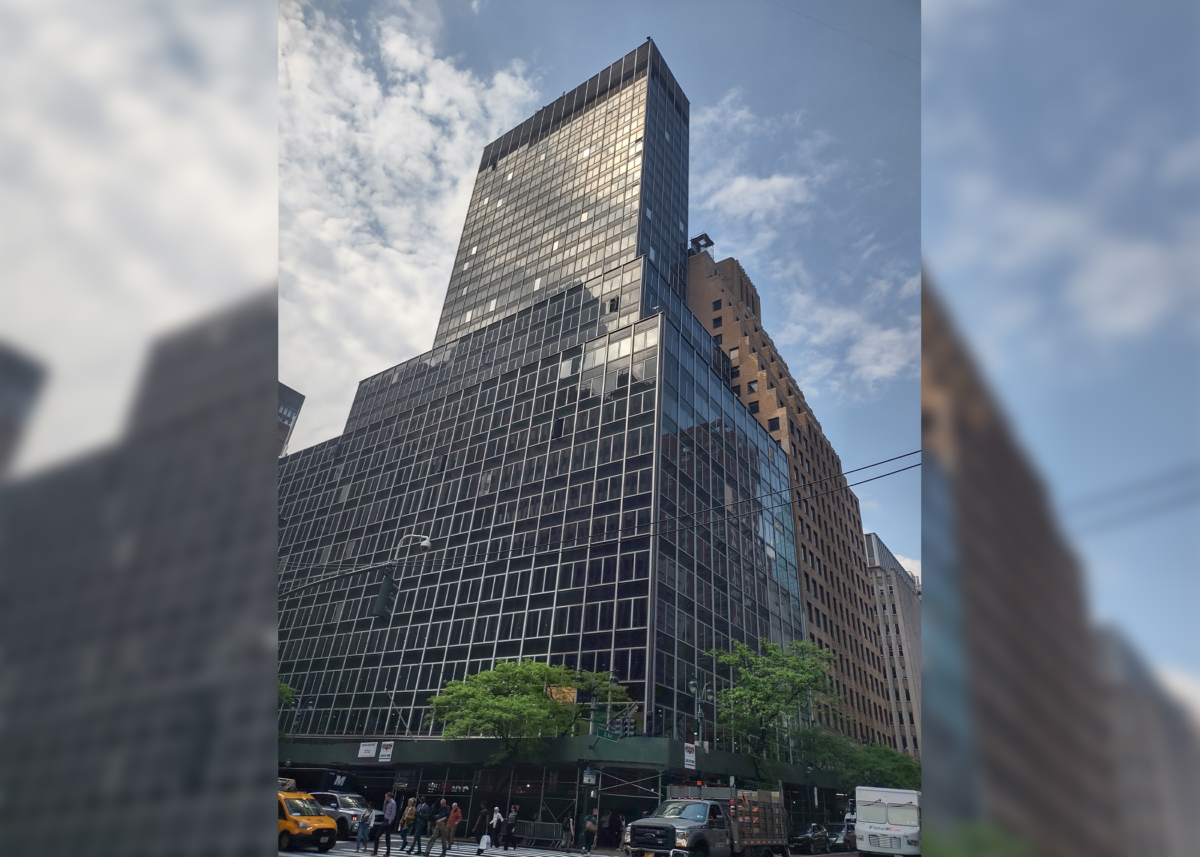
HOA Detective | July 10, 2026: The structural emergency at the former Pfizer headquarters redevelopment at 235 East 42nd Street in Midtown Manhattan¹ should become required reading for anyone involved in condominium development, engineering, lending, or public policy. Investigators have not yet reached final conclusions regarding the cause of the structural distress discovered during construction.
The development involves the conversion of the 37-story, 66-year-old Pfizer headquarters tower and an adjoining building dating to 1910 into approximately 1,600 condominium units. During the conversion of the aging office tower, workers discovered significant structural distress, prompting evacuations, emergency stabilization efforts, and an intensive engineering investigation. ²
Authorities have since reported that the building has been stabilized while the underlying cause remains under investigation.
Inquiring minds are asking why such an ‘investigation” was not carried out BEFORE the decision was made to allow the two buildings to be converted to 1,600 housing units.
The Project Exposes a Larger Issue: When extraordinarily complex buildings are converted into common-interest housing, future owners inherit engineering risk that cannot be seen in a sales brochure. The former Pfizer HQ redevelopment is an ideal anchor for a broader discussion because it illustrates the cumulative nature of condominium risk factors.
The issue is not simply age, height, or size of a property. The risk analysis for a project of this scope is a non-linear multi-formula model with several layers of complexity each impacting the prospect for a successful long-term outcome.
- The first layer is the condominium form of ownership itself.
- The second layer is height. As buildings rise, engineering systems become more sophisticated and interdependent. Owners cannot independently repair a structural frame, replace a vertical plumbing riser, maintain elevators, or modernize life-safety systems. High-rise living concentrates both convenience and collective risk.
- The third layer is age. Converting a building that has already served sixty years or more does not erase its engineering history. It merely transfers responsibility for that history from a commercial owner to a residential association. The older the structure, the greater the importance of understanding prior repairs, alterations, deferred maintenance, and remaining service life.
- The fourth layer is adaptive reuse involving multiple generations of construction. Integrating a twentieth-century high-rise with an adjoining building dating to the early twentieth century introduces differing construction methods, materials, design assumptions, and maintenance histories. None of these conditions makes success impossible, but each requires careful engineering evaluation.
- The fifth layer is scale. The reported plan is for an estimated 1,600 residential units occupying a remarkably compact site. A community of that size creates extraordinary governance complexity. Budgeting, reserve funding, insurance, capital planning, inspections, emergency response, and board decision-making become significantly more challenging simply because so many owners share the same infrastructure.
These five characteristics are why policymakers should require comprehensive independent architectural and engineering assessments before major conversions are permitted to move forward.
Such examinations should establish a permanent engineering baseline that becomes part of the disclosure record for every purchaser.
United We Stand, Divided We Fall: The location of the project adds another dimension. Situated only a short distance from the United Nations Headquarters, any significant event at the property is likely to receive international media attention. Whether the redevelopment ultimately becomes an engineering success story or a cautionary tale will be determined by the ongoing investigation.
The policy lesson should already be evident in the aftermath of the Champlain Tower collapse: extraordinary complexity deserves extraordinary diligence. Aging high-rise buildings demand the utmost attention to the details before the first certificate of occupancy is issued.
Condominium Complexity Index™: The HOA Detective™ believes the time has come to move beyond subjective descriptions such as ‘high risk’ or ‘complex project’ descriptions. With this in mind, he has instructed his team at CIDAnalytics to begin an “investigation” of their own. One that will lead to the CIDA Condominium Complexity Index™ (CCI™) that objectively rates the inherent complexity of a condominium based upon measurable characteristics such as building height, age, adaptive reuse, structural configuration, ownership scale, shared infrastructure, and governance demand.
The CCI™ will not measure whether a condominium is well-managed or poorly governed. Other metrics in the CIDA arsenal are available for other aspects of the due diligence endeavor:
- The CIDA SCORE™ measures disclosure quality and governance-related risk.
- The CIDA Owner’s Stress Index™ OSI™ measures the owner’s implied financial stress related to owning a particular condominium property.
- A current reserve study measures capital needs.
The CCI™ will measure the engineering and operational complexity of the subject property. The Index will reflect the degree to which a condominium organization embraces the K.I.S.S. principles ⁴ at the point of project inception, or whether the complexity warrants a contrarian position simply because of the underlying physical attributes, legal structure, or demographics.
Because You’re Buying More than a Home™
Sources
- Associated Press. Coverage of the former Pfizer headquarters structural emergency and stabilization efforts, July 2026: https://www.wqad.com/article/news/nation-world/manhattan-high-rise-stabilized-some-evacuations-lifted/507-1f5cd606-613d-4459-9d57-4ddc610612b5
- Wall Street Journal. ‘What We Know About Efforts to Stabilize the Former Pfizer Building in Manhattan.’ July 2026: https://www.wsj.com/us-news/what-we-know-about-efforts-to-stabilize-the-former-pfizer-building-in-manhattan-8eca536d
- National Institute of Building Sciences. Whole Building Design Guide: Building Condition Assessment and Life-Cycle Asset Management.
- HOA Detective™ | July 15, 2025: https://hoadetective.com/the-search-for-the-successful-hoa-k-i-s-s/
- Cover Image. By Jim.henderson – Own work, CC BY-SA 4.0, https://commons.wikimedia.org/w/index.php?curid=164938199